

Home / Products / Robotics / Painting robots / Coating Robots
Large steel structures with complex geometries, multiple brackets and stubs, and strict coating specifications demand a level of consistency and repeatability that manual application cannot reliably deliver.
Ventherm supplies complete coating robot systems for heavy industry built around ABB paint robots and automatic programming software from our long-term partner Inropa. Every system is commissioned as a complete, operational unit ready to integrate into your production.
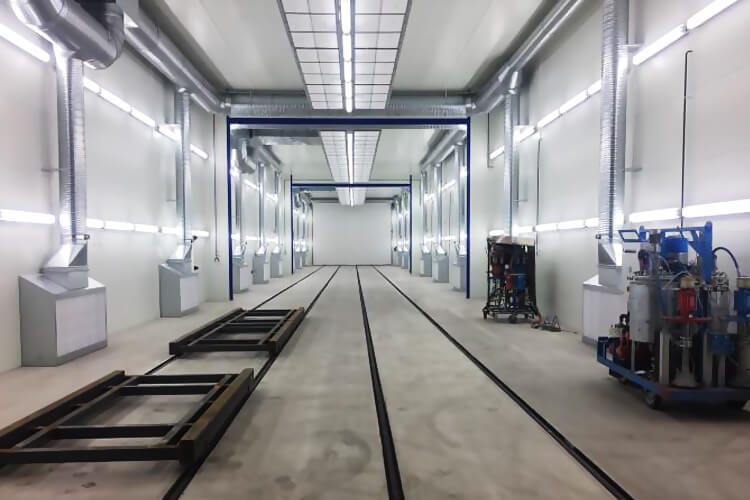
Your component geometry determines the right configuration. Gantry systems suit varied shapes and sizes, while floor-driven systems are built for large cylindrical components that rotate during application.
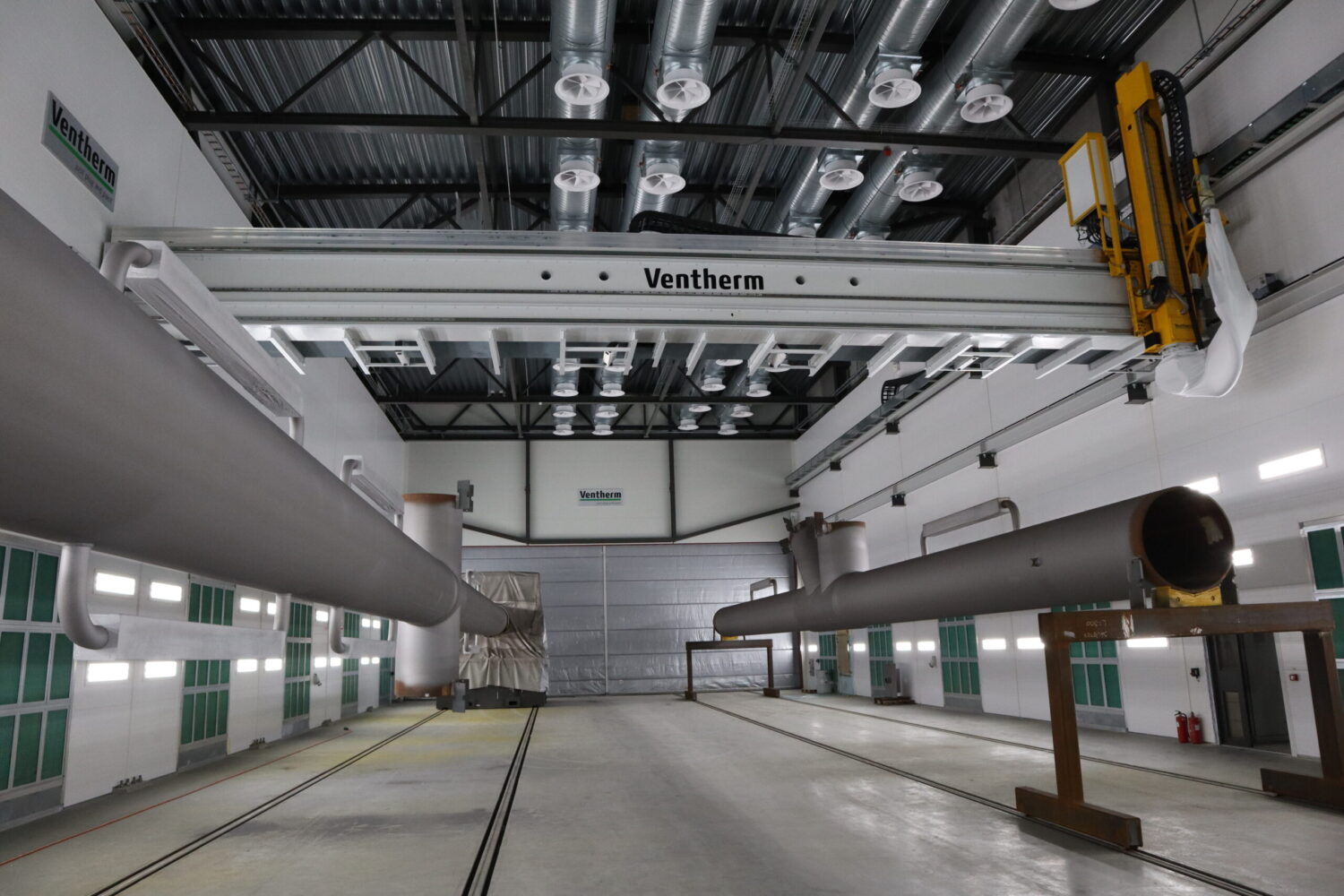
Gantry systems operate across three linear axes (X, Y and Z), giving the robot full freedom of movement above the component. This allows it to cover significant surface areas on large structures, processing 300-400 square metres per hour, without fixed tooling or manual repositioning. Airless application is standard, and spray parameters including angle, speed and pressure are adapted automatically for each surface type.
Floor-driven systems use a rail-mounted wagon with a 5-metre X-axis and a 6-axis ABB IRB 5500 spray painting robot. The wagon advances in sections along the component while the part rotates on roller beds. The robot sprays in 5-6 metre strokes, then the wagon moves forward and the process repeats. Polyurethane and epoxy systems are supported, including glass flake variants, at booth conditions of 20-25°C and 50-75% humidity.
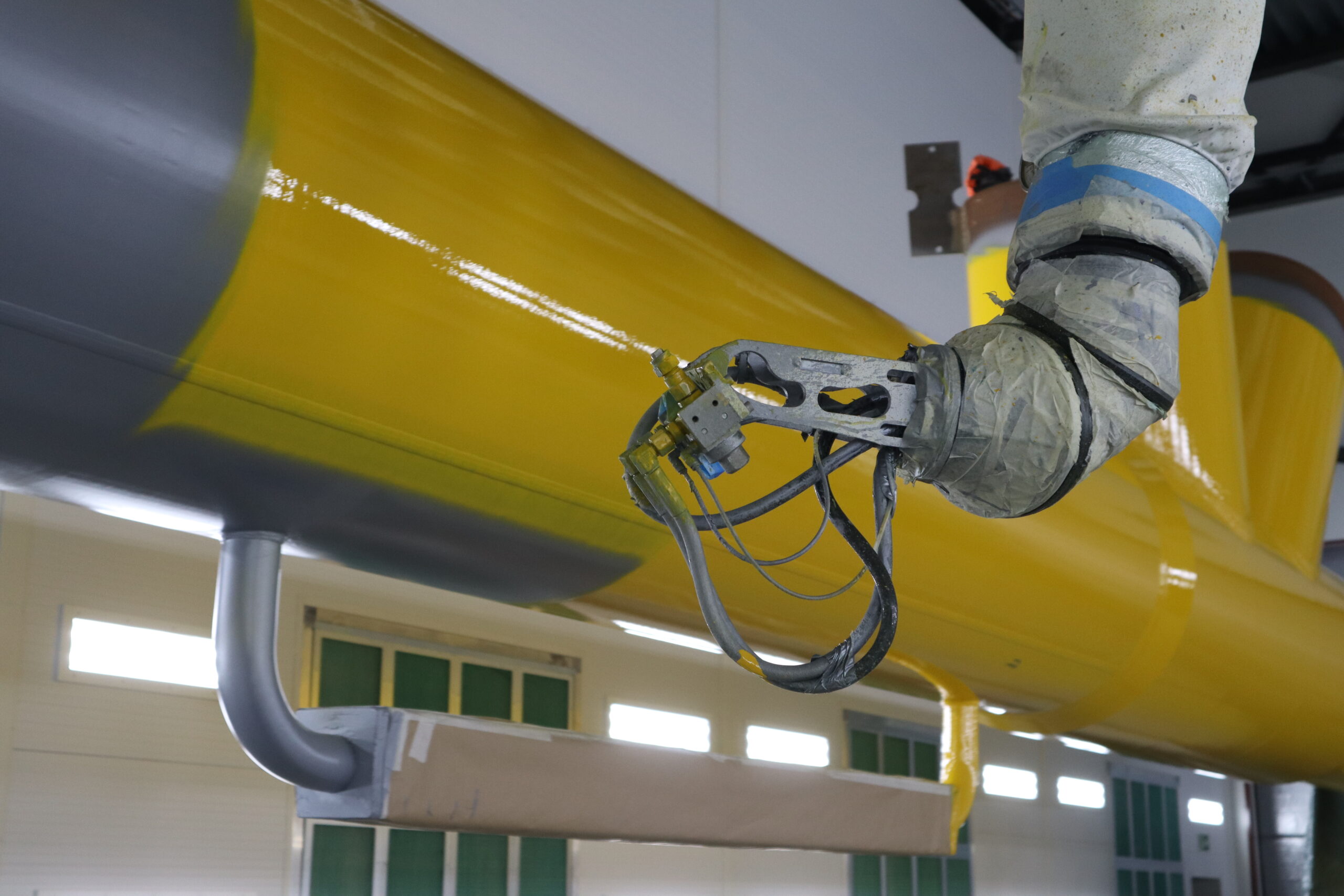
Robots for powder coating are used where electrostatic application better suits the component or finish requirement. These systems handle particle charging and distribution consistently across the surface, with integrated overspray recovery that recycles unused material. The right choice depends on your coating specification and the surface properties of the substrate.
Our coating robot systems integrate directly into your existing booth layout without requiring structural modifications. Gantry configurations are adapted to your booth dimensions, and floor-driven systems run on rails integrated into the booth floor. Before manufacturing begins, we run a full simulation of your specific setup to confirm reach and surface coverage across all component sizes.
Before shipment, your system is pre-commissioned and tested at Ventherm’s facility in Denmark. Our PLC-based control system gives your team full monitoring access from a PC or smartphone, and remote support from our Inropa specialists is available throughout operation.
Lead time from order to commissioned system is agreed during the simulation phase before manufacturing begins.
For standard profiles and geometries, the Inropa Automatic Programmer generates a complete robot path in as little as 30 seconds. For larger, more complex components with multiple add-on geometries, program generation typically takes around five minutes. Automatic programming covers 90-95% of the surface area on complex components such as transition pieces. The remaining areas can be handled manually or left to touch-up painters. Programs are created off-line and sent directly to the robot without interrupting your production line.
Operator training takes three days for standard operation. Operators handling more complex programming tasks complete a five-day course. Prior robotics experience is not required – prior knowledge of coating processes matters more than software experience.
English
Dansk
Svenska
Deutsch
Español
Français
Looking for further information? Please read Ventherm’s catalogue for product designs, company merits, and specifications for use and implementation.


Every project starts with your components, your booth, and your production targets. Ventherm delivers complete, ready-to-operate systems. Contact us for a non-binding discussion about your painting robot solution.
All our coating robot systems are certified for Zone 2 ATEX environments from the outset, not adapted for compliance after the fact. Lubrication systems are positioned outside the hazardous zone, and all cabling, tubing, and pneumatic components meet the relevant ATEX requirements. This applies to both gantry and floor-driven configurations.
Documented savings range from 25-35% compared to manual application. At the Aker Solutions project in Norway, savings reached 32%. The savings are driven by precise path generation and controlled application parameters, which significantly reduce overspray compared to manual coating.
Our systems support multiple materials through separate feed lines. Colour changes are automated – the robot flushes between materials, preventing contamination and maintaining consistent quality across layers.
Most installations run with one to two operators per shift. The system handles programming, path generation, and process monitoring automatically – operators manage loading, oversight, and quality checks.
Routine maintenance covers camera cleaning for the vision system, calibration verification, and standard checks on motion systems. Lubrication is automated and positioned outside the ATEX zone. Most customers run preventive maintenance quarterly, with daily checks carried out by operators during each shift.
A gantry system moves across X, Y, and Z axes above the component and suits operations with varied component sizes and geometries. A floor-driven system runs on rails and is optimised for large cylindrical structures where the part rotates on roller beds during application. The right configuration depends on your component type, booth layout, and production setup.