Floor-driven Robot for Large-Scale Surface Treatment

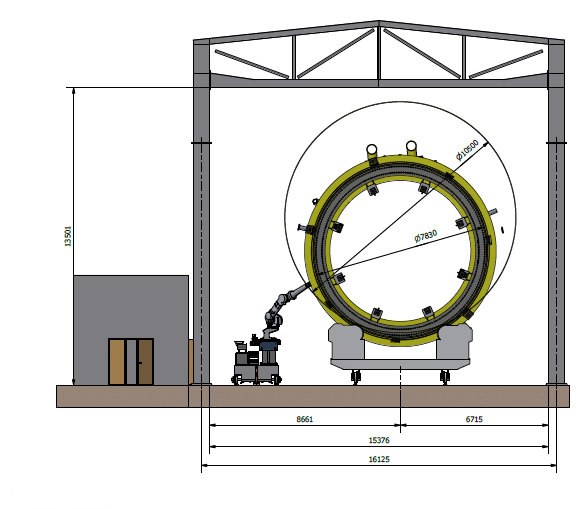
A Floor-driven Robot is a robot solution built for surface treatment of large and complex components that other systems cannot reach. Mounted on a rail-guided wagon that travels along the production floor, the robot advances alongside the component as it rotates on roller beds – covering the entire surface section by section, without the limitations of fixed or overhead systems. This makes it particularly well suited for components with diameters of 7.5 to 9.5 metres and surface areas exceeding 600 square metres, where standard robot configurations do not have sufficient reach or flexibility.  

How does a Floor-driven Robot differ from other robot systems?

  • Most robot systems are mounted in a fixed position or on an overhead gantry. With a Floor-driven Robot, the wagon travels on rails at floor level, running alongside the component rather than above it. This gives the robot access to surfaces on components that would be unreachable with any other configuration.
  • The robot is mounted on a 5-metre vertical axis on the wagon and covers a 5-6 metre section of the surface at a time. Once complete, the wagon advances and the process repeats – typically in 5-6 steps for a full transition piece.
  • The system can handle components up to 30 metres long and up to 10 metres in diameter.
What components can a Floor-driven Robot handle?

Floor-driven Robots are built for components that exceed the reach and capacity of other robot systems. Typical applications include offshore wind transition pieces with surface areas of up to 638 square metres and diameters from 7.5 to 9.5 metres – components that our painting robots and sandblasting robots are specifically configured for in this setup.

The Inropa™ Automatic Programmer handles complex geometries automatically, including flanges, pipe stubs and brackets, and approximately 90-95% of the surface area can be programmed without manual intervention.

Ventherm A/S Spray and paint booth

How is the surface treatment automated?

Before processing begins, a 3D scanning system maps the component’s actual position. The Inropa™ PoseFitter module compares the scan data with the component’s CAD model and compensates for positional deviations of up to 100 mm, ensuring the robot programme matches the physical reality of each component.

The Inropa™ Automatic Programmer then calculates optimised robot paths and transfers them directly to the robot. Our automated paint system handles polyurethane and epoxy – including epoxy with glass flakes – across both painting and blasting operations.

Inropa has developed software for controlling paint robots for more than 20 years, with the technology used across more than 25 fully automated installations worldwide.

Ventherm Katalog

Ønsker du yderligere oplysninger? Læs venligst Ventherm-kataloget for at se produktdesign, virksomhedens fordele samt specifikationer for brug og installation.

Flag UK
Flag Denmark
Flag Sweeden
Flag Germany
Flag Spain
Flag france

Get advice on the Floor-driven Robot

If you have questions about the Floor-driven Robot or would like to know more about what the system can do for your production, you are welcome to contact us. In line with our Plug-and-Paint philosophy, we deliver complete, ready-to-operate solutions and provide advice specific to your production setup – helping you assess whether a Floor-driven Robot is the right choice, or whether a different robot configuration would better suit your needs.

FAQ

A Floor-driven Robot is a rail-guided robot system that carries out automated surface treatment on large components at floor level. The wagon travels alongside the workpiece, covering the surface in sections while the component rotates on roller beds – giving it access to components up to 30 metres long and 10 metres in diameter.

In a Floor-driven configuration, both painting and sandblasting require only 1-2 operators per shift. Our spray painting robots and sandblasting robots deliver the following results:

Painting

  • Treatment time: 100-130 minutes per reference transition piece
  • Automated coverage: approximately 98% of the surface
  • Paint consumption: approximately 25% lower than manual application

Sandblasting

  • Treatment time: 300-330 minutes per reference transition piece
  • Capacity: 120-140 m² per hour
  • Automated coverage: approximately 98% of the surface
  • Productivity increase: up to 66% compared to manual methods

Floor-driven Robots are the right choice when processing components at a scale where overhead or stationary systems cannot provide sufficient reach or coverage. Offshore wind manufacturers producing transition pieces and large offshore steel structures typically see the fastest return on investment.

If your production involves smaller components or standard geometries that fit within conventional robot reach, an In-Line Robot or Gantry Robot may be a more suitable solution.

A Floor-driven Robot is programmed automatically via 3D scanning and the Inropa™ Automatic Programmer – no manual robot programming is required. The system generates programmes directly from the component’s CAD model and applies template programmes for recurring features such as brackets and flanges. The majority of the surface can be programmed without manual intervention.

A Floor-driven Robot performs both painting and sandblasting. For painting, the system applies polyurethane and epoxy – including epoxy with glass flakes – in two- and three-coat systems. For blasting, it removes mill scale, rust and old coatings from large components while they rotate on roller beds. The system can be configured for various surface treatment tasks depending on the requirements of the components and the specific production.

The wagon measures approximately 2.4 x 5 metres and travels on rails installed at floor level. Rail lengths are configured to match your component dimensions and facility layout. We always adapt the solution to your specific production setup.