Spray painting robots

Spray painting large industrial components requires precision and consistency on every part. As production volumes increase, maintaining that level of quality with manual application becomes a challenge.

A dedicated painting robot automates the process and delivers repeatable results. At Ventherm, we provide complete painting robot solutions for heavy industry, combining 3D scanning with automatic programming. That means you can start painting without dedicated robot programmers on staff.

What is a spray painting robot?

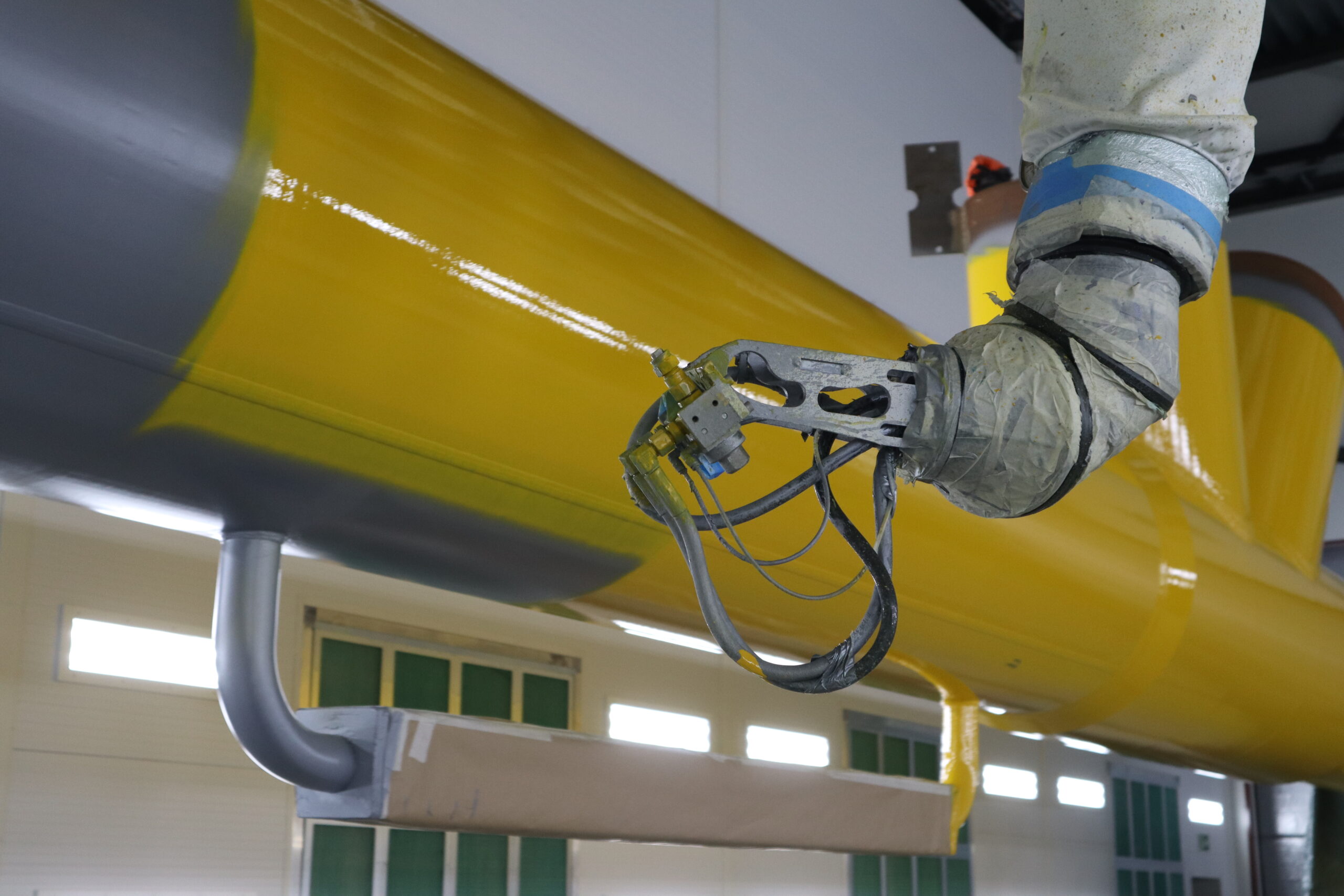
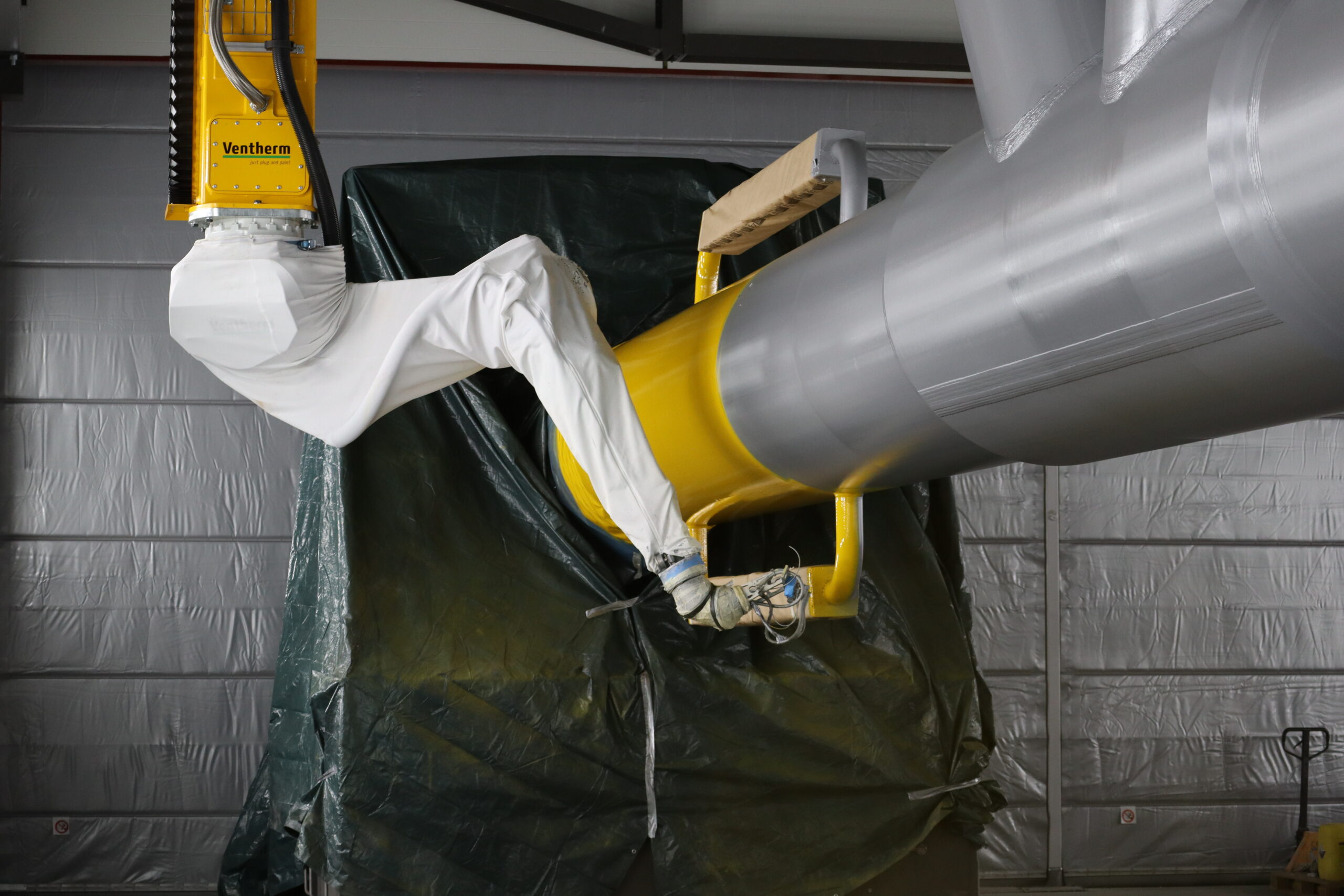
A spray painting robot is an automated system that applies paint, primers, or other coatings to industrial components. The robot follows programmed paths across the surface of each part, controlling spray angle, distance, and speed. Depending on the application, it can be equipped with airless spray guns, electrostatic sprayers, or air mix spray guns.

Applications in heavy industry

Typical applications include wind turbine blades, offshore transition pieces, railway equipment, and agricultural machinery. The spray robot operates within a spray booth maintained at 20-25°C with humidity between 50% and 75%.
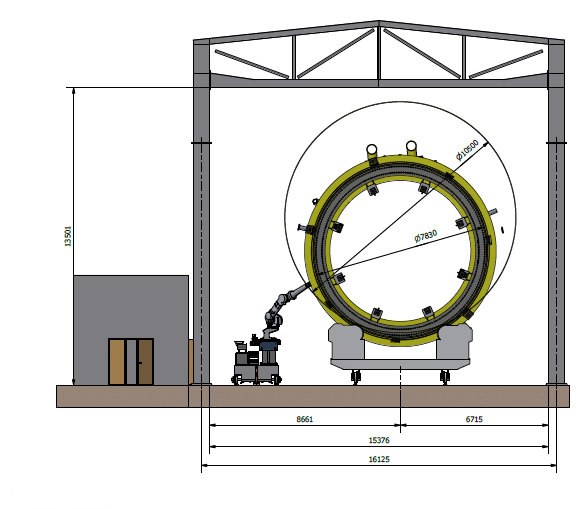
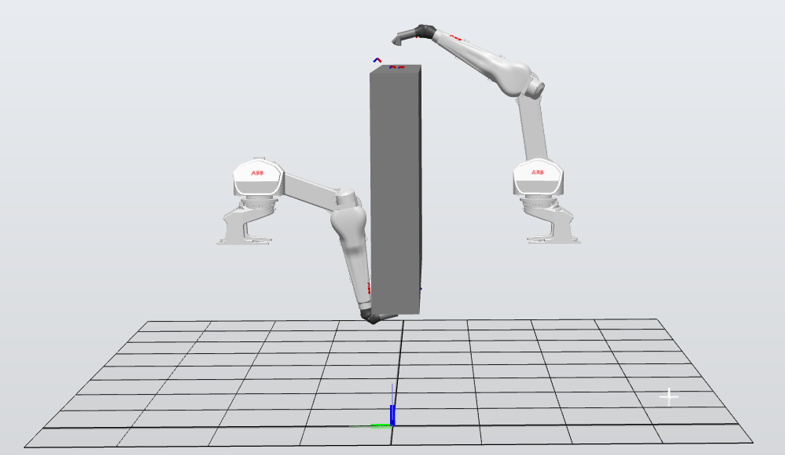
Gantry and floor-driven configurations

Spray painting robots in heavy industry are available in two main configurations:

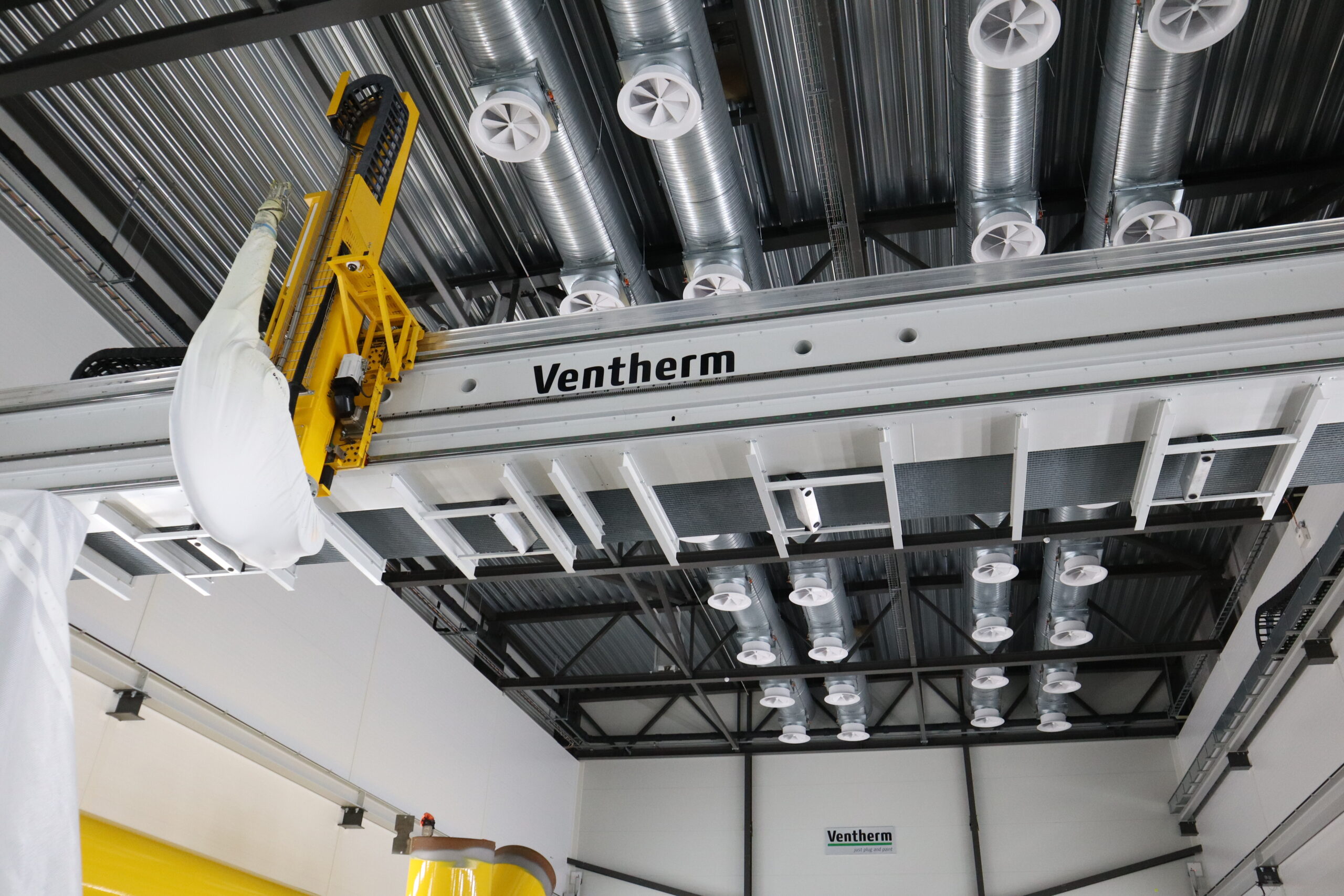
  • A gantry robot operates on a three-axis linear module (X, Y, and Z) mounted under the ceiling of the booth
  • A floor-driven wagon runs on rails along the length of the booth, with control rail lengths up to 100 meters

The robot is typically a 6-axis ABB IRB 5500 or 5510, ATEX-approved for operation in ATEX Zone 2. Both configurations are controlled through Beckhoff PLC via Ethernet/IP and can be monitored remotely through Ventherm’s app or a PC.

Inline robot painting for continuous production

For facilities that process high volumes of steel profiles, we offer an inline configuration that keeps parts moving through the booth on a conveyor. Two ABB paint robots are mounted on opposite sides of the line, each equipped with a double gun system and an optional vertical lifting axis as a 7th axis.

Before entering the spray booth, each traverse passes through a scanning cabin with eight 3D cameras. The SteelPainter software matches the point cloud against the CAD model, generates programs for both robots, and sets the conveyor speed individually for each traverse. The system handles H-beams, I-beams, and rectangular profiles up to 16 metres in length.

Paint application and process control

The paint delivery system maintains constant flow rate and pressure. Sensors monitor viscosity, temperature, and pressure in real time to prevent defects such as runs, sags, and orange peel.

For large components, the robot works in sections – spraying 5-6 meter strokes, then advancing along the external axis and repeating the process. This approach allows the system to handle structures of virtually any length while maintaining consistent coating thickness throughout.

Automatic programming with 3D scanning

Traditional industrial robots require offline programming for each new part. For gantry and floor-driven configurations, Ventherm’s automatic painting robot systems eliminate this through 3D scanning combined with automatic path generation.

From scan to paint-ready program

A 3D scanning system captures a point cloud of the unpainted component. The PoseFitter system matches this point cloud against the imported CAD model and aligns it to the exact position and orientation of the physical part. Based on this alignment, the Automatic Programmer generates the robot program and sends it directly to the controller.

The part does not need to be placed with high precision in the booth – the system compensates automatically. Calculation takes approximately 30 seconds for smaller components and around five minutes for large structures.

Template programs for complex geometries

For features such as flanges, pipe stubs, and brackets, the system uses pre-built template programs. These are created once and automatically applied when the scanner recognizes those features on a new part.

Full system integration in a robotic spray booth

The robot is part of a complete finishing system that includes part handling, booth ventilation, drying, and quality control. With a single-source solution, all components are designed and tested as one coordinated system.

At Ventherm, we design paint facilities where the spray paint robot integrates with ventilation systems, heat recycling with up to 75% energy recovery, zone ventilation, and humidity control.

How spray painting robots improve production

Manual painting takes time, and results vary even between skilled operators. A spray paint robot removes that variability and delivers clear production benefits:

  • A robot paint sprayer applies the same coating in the same pattern every time, covering up to 98% of the surface area with only limited manual touch-up in hard-to-reach corners
  • Optimized spray patterns and transfer efficiency reduce paint consumption, with savings typically ranging from 25% to 35% compared to manual spraying
  • A paint spraying robot works continuously without breaks and switches between part types without programming downtime, since new paths are generated directly from a 3D scan
  • Automating the painting process removes operators from hazardous ATEX-classified environments – instead, they monitor operations from outside the booth via the HMI panel, Ventherm’s app, or a PC

Ventherm Catalogue

Looking for further information? Please read Ventherm’s catalogue for product designs, company merits, and specifications for use and implementation.

Flag UK
Flag Denmark
Flag Sweeden
Flag Germany
Flag Spain
Flag france

Getting started with a spray painting robot in your facility

Implementing a robot solution requires careful planning, and our team supports you through every stage – from concept development through installation and training. 

We work closely with our customers to deliver a complete, ready-to-operate system. That is our Plug-and-Paint philosophy in practice. You receive a painting robot solution that is fully integrated and prepared to run without delay. With over 40 years of experience in surface treatment equipment for heavy industry, we understand both the technical requirements and the practical realities of industrial finishing operations. 

Contact us for a non-binding conversation about your requirements. We are ready to help you find the right solution for your production.